





Chinese currency culture is an important component of China's outstanding traditional culture and serves as the origin and representative of Eastern monetary culture. Within the square and round shapes lies the universe. The exhibition hall gathers various collections such as cowrie shells, knife coins, spade coins, round coins with square holes, metal coins, and paper money, vividly showcasing the social life, political changes, and historical processes of diverse ethnic cultures across different eras in the region. Visitors can explore the origin and evolution of ancient coins through their diverse forms, appreciate the profound depth of coin culture, and experience the historical and cultural beauty embodied by these currencies.
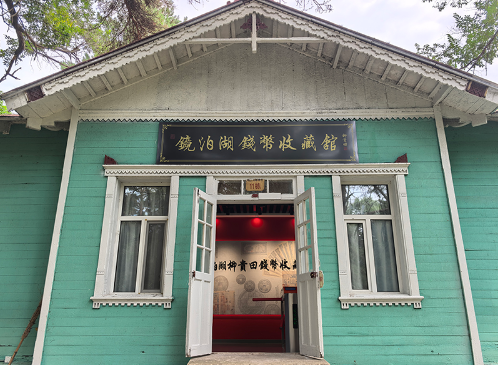
China is one of the earliest countries in the world to use currency. Over thousands of years, money evolved from primitive forms to metal coins, giving rise to the world's earliest paper currency and later developing into modern digital currency, reflecting the socio-economic, cultural, and technological changes in the nation.
During the Xia and Shang dynasties, shell money became China's earliest currency. Many Chinese characters related to wealth and trade feature the radical "贝" (shell), and shell money was measured in units called "peng." As society progressed, the supply of seashells became insufficient, leading to the emergence of jade shells, bone shells, stone shells, and bronze shells. In the Spring and Autumn and Warring States periods, various bronze coins circulated widely: inscribed "ant-nose coins" were convenient for trade and transport; "spade coins," derived from farming tools, transitioned from thick and heavy to thin and light; "knife coins," originating from daily utensils, came in diverse shapes; and "round coins" used in Qin and Wei, as precursors to square-hole coins, ushered in the era of round-hole coins.
After unifying the six states, the Qin Dynasty introduced the Ban Liang coin inscribed by Li Si, establishing the round-with-a-square-hole coin paradigm as China's earliest unified currency, a design that persisted until the late Qing Dynasty. During the Han Dynasty, Emperor Wu centralized coinage authority and minted the Wu Zhu coin. Wang Mang's regime implemented currency reforms, producing exquisitely crafted coins that rank among ancient numismatic masterpieces, though the reform's failure contributed to the rapid collapse of his Xin Dynasty.
In the Tang Dynasty, Li Yuan abolished Sui coins and initiated the casting of Kai Yuan Tong Bao. Designed by calligrapher Ouyang Xun, this coin abandoned weight-based nomenclature, establishing the "Tong Bao" system that endured until the Republic of China era. Song Dynasty coin culture flourished: Song Yuan Tong Bao marked the dynasty's founding; imperial calligraphy coins integrated art with currency, pioneered by Emperor Taizong and reaching its zenith with Emperor Huizong's slender gold script. Northern Song's commercial boom spurred the world's earliest paper money—Jiaozi—which gained legal tender status in 1024 with the establishment of the Yizhou Jiaozi Office. Ancient coins evolved through clay molds, stack casting, and sand casting techniques, while printing advancements enabled paper currency.
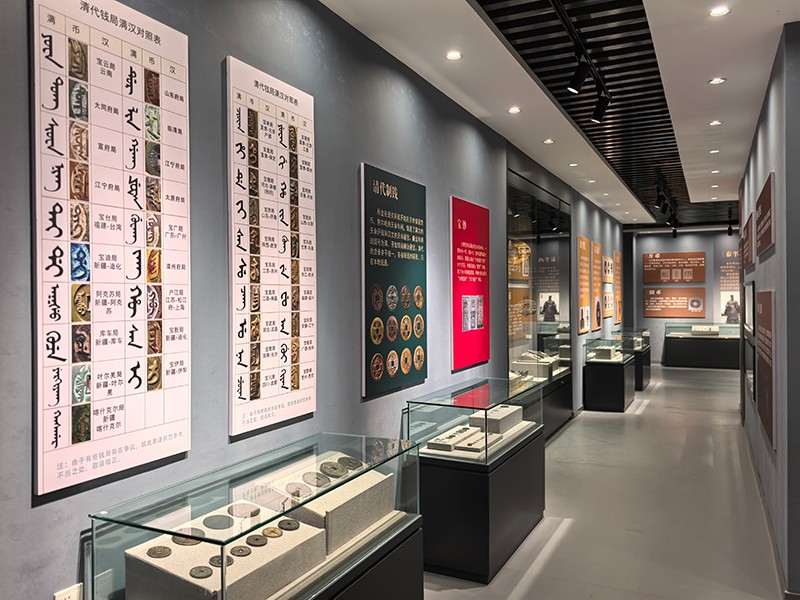
Yuan Dynasty made paper money its primary currency, documented by Marco Polo's travels. During the Ming Hongwu era, Da Ming Bao Chao—printed on mulberry paper—became China's largest-format banknote. Yongle Tong Bao, minted in the Yongle period, served mainly for diplomacy and rewards. The Qing Dynasty produced traditional coins like Tian Ming Tong Bao and Shun Zhi Tong Bao, with provincial currencies circulating locally. By the Guangxu era, foreign machinery was imported to mint Da Qing Copper Coins. Foreign silver dollars entered China during the Wanli period; in 1890, the Qing court issued "Guangxu Yuan Bao" dragon silver dollars, which remained key currency into the Republic era. Republican China saw diverse currencies—silver dollars, copper coins, and paper money coexisted, with the 1914 Yuan Shikai silver dollar maintaining circulation well after the PRC's founding.
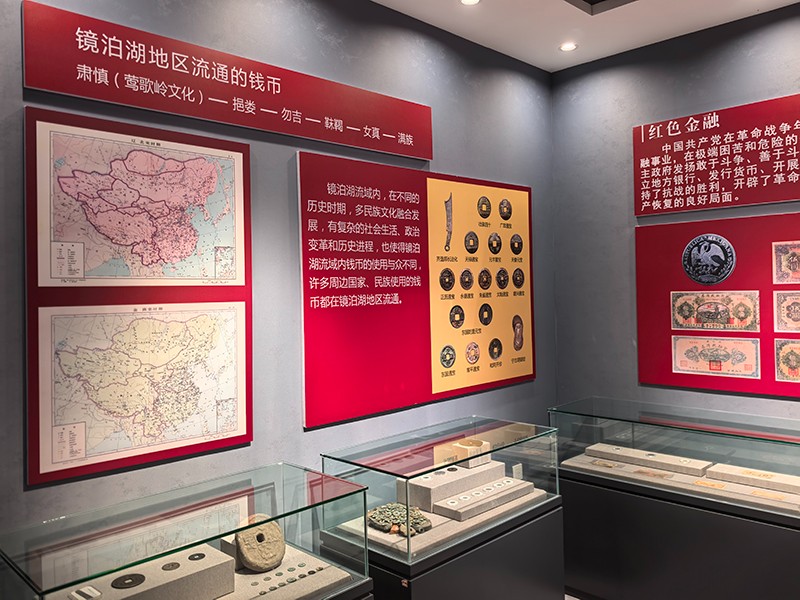
The exhibition includes displays on red finance. During revolutionary wars, base areas overcame immense challenges to establish financial systems, issuing currencies to support resistance efforts. The "Eagle Dollar with '工' Mark" exemplifies red finance. Post-war, Northeast China saw banks issuing notes like the 1946 Mudanjiang Industrial Bank Note, backed by coal trade and later replaced by Northeast Bank Notes circulating until 1952. On December 1, 1948, the People's Bank of China issued the first RMB series, founding New China's legal tender system.
In addition to circulating currency, the exhibition hall also showcases traditional coin folk culture. Coins are deeply integrated into wedding and festival customs, with various folk objects shaped like coins embodying the people's aspirations for longevity, auspiciousness, favorable weather, and national peace and prosperity.
Welcome to the Jingpo Lake Coin Museum, where you can explore the profound and enduring Chinese monetary civilization through these ancient coins.